Episode transcript
Nuclear Hotseat #799 - October 20, 2026
San Onofre Vulnerabilities Post-Rachel Storms -
Oceanographer Kim McCoy
+ Nuclear/NASA Connection, Karl Grossman
Libbe HaLevy: [00:00:00] Nuclear vulnerability. The remains of the
decommissioned San Onofre Nuclear Generating Station in Southern California
contains 73 thin-walled canisters of highly radioactive plutonium-containing
waste that sits only 100 feet from the Pacific Ocean's normal high tide mark.
But given the one-foot rise in sea level in the Pacific, combined with massive
storms created by Hurricane Rachel that so devastated the beaches, beachfront
houses, and flooded towns throughout Southern California, how did San Onofre
hold up?
What might this do to, say, the seawall intended to protect San Onofre? It takes
a genuine expert, someone fully aware of all the ocean-based problems still
posed by this site, to understand and explain. And when he tells you-
Kim McCoy: A cubic yard of water weighs a [00:01:00] ton. And if this ton of
water is coming at you at 20 miles an hour, you don't want to be there.
Wave forces do damage on structures. Wave forces on structures are very, very
significant. Those structures are battered by these tons and tons of water. I just
said a cubic yard. A wave contains hundreds and hundreds of cubic yards. So
imagine the sea launching boulders up against that seawall every 10 seconds
forever.
It's not hard to imagine what's going to happen. The boulders will get made into
smaller pieces of rock, and the seawall will get made into smaller pieces of
seawall. That's what happens.
Well, when an internationally recognized physical oceanographer and NATO
Scientific Achievement Award recipient, Kim McCoy, lets you know what San
Onofre, and thus those of us who live in Southern [00:02:00] California, face in
Rachel's aftermath and the predicted El Nino storms coming, you get a sense
that we are all being slammed down into a really bad example of that awful,
deadly, dangerous seat that we all share.
Nuclear Hotseat Theme: Nuclear Hotseat. What are those people thinking?
Nuclear Hotseat. What have those boys been drinking? Nuclear Hotseat. The
corium is sinking. Our time to act is shrinking, but our activists are linking.
Nuclear Hotseat. It's da bomb
Libbe HaLevy: Welcome to Nuclear Hotseat, the weekly international news
magazine keeping you up to date on all things nuclear from a different
perspective. We're a show for people who know nothing [00:03:00] about
nuclear who wanna know something, and people who know something who
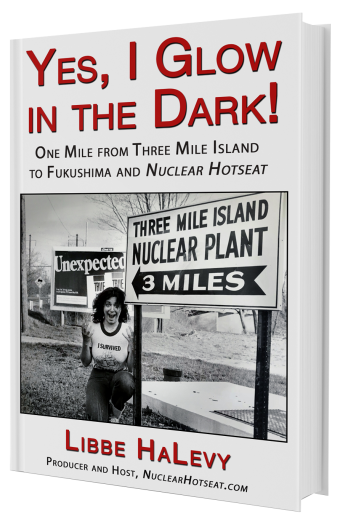
would like to know just a little bit more. My name is Libbe HaLevy
I'm the producer and host, as well as a survivor of the nuclear accident at Three
Mile Island from just one mile away, so I know what can happen when those
nuclear so-called experts get it wrong This week, in the wake of the devastating
post-Hurricane Rachel storms that inundated coastal towns in Southern
California, we consider what problems this might pose to San Onofre's nuclear
generating station.
We talk with physical oceanographer Kim McCoy. Learn what a constant
pounding of waves against the seawall at San Onofre that's supposed to protect
the seventy-three San Onofre canisters, each packed with as much radioactivity
as was released at Chernobyl, and what Southern California Edison, the owner-
operator of the site, is doing to protect [00:04:00] us.
All of that will be coming up shortly. We'll also have award-winning
environmental journalist Carl Grossman expanding on his recent Counterpunch
article on the nuclear-NASA connection involving proposals for the Moon and
Mars, as well as history on previous accidents and problems. And we will have
nuclear news from around the world, numbness of the week for outstanding
nuclear boneheadedness, Linda Pence Gunter back with the Nuclear Hotseat hot
story, and lots of honest and verifiable nuclear information, all of it coming up
in just a few moments.
Today is Tuesday, October 20th, 2026, and here is this week's nuclear news
from a different perspective. Starting out in Michigan, where the U.S. Nuclear
Regulatory Commission has granted permission to Holtec International, owners
of the shuttered Palisades Nuclear Reactor, [00:05:00] to retrieve a potentially
compromised fuel assembly.
Oh, the plant received a warning about its work environment at the same time.
At some point after August 30th, as new fuel was being lowered into the reactor
for a planned restart, one of the fuel assemblies tipped, causing the plant's
planned restart to be placed on hold. If Holtec successfully retrieves the fuel
assembly, efforts to restart the plant are likely to move forward with NRC
oversight.
Oversight being one of those words that means both overseeing and
overlooking. Kevin Kamps, executive director for environmental advocacy
group Don't Waste Michigan, said Holtec's unprecedented restart of the
Palisades zombie reactor will risk a Chernobyl or Fukushima-scale catastrophe
a hundred yards from the shoreline of the Great Lakes, drinking water supply
for more than forty million people in eight U.S.
states, two Canadian provinces, and a large number of Indigenous nations.
[00:06:00] Arnie Gunderson, a nuclear engineer and expert advisor for the
organization, called the NRC's decision to approve Holtec's strategy for
retrieving the tipped fuel assembly ironic. Gunderson said, "In the past four
weeks, Palisades lost control and tipped a nuclear fuel bundle and couldn't get it
out.
Nine out of 15 licensed reactor operators failed their exam, and more than half
of the people in their quality assurance and procurement departments feel they
will be fired by management if they bring concerns forward," he said. "And yet,
ironically, the NRC just gave them permission to begin loading fuel again."
Regarding the financial world's view of nuclear reactors, Linda Pentz-Gunter
asks, "Is it a deep dive into oblivion for Deep Vision and the other nuclear
startups soon to fall into the money pit?" Linda Pentz-Gunter is back with
[00:07:00] another Nuclear Hotseat hot story.
Linda Pentz Gunter: A recent report by Iceberg Research looked at the
financial prospects for one of the many new nuclear startup companies.
It ran the deliciously punny headline, Deep Vision, a Money Pit. What followed
was a damning report about the big promises made by the Berkeley, California-
based ingenue company and its utter failure to deliver anything credible, either
financially or technologically. Its shares duly fell into same pit.
Deep Vision trades under the name FISN. It isn't doing well so far, as the
Iceberg report noted. Quote, "With no advantage in either speed or cost, FISN
will not be a winner in this increasingly crowded market," Iceberg concluded.
Pressing ahead with the IPO despite having to slash the offer price looks like a
late attempt to ride the SMR hype and dump a stranded asset onto retail
investors.
That crowded market, though, [00:08:00] is also pretty shaky. Late in its report,
Iceberg featured a marvelous graph showing the recent trajectory of nuclear
shares on the stock market. I know this isn't a good medium for talking about
graphs since you can't actually see it, but try to picture Donald Trump's
signature written with multiple different colored markers and in multiple sizes.
Yes, it basically looks like a lot of scribbling, a bunch of little colored lines
going up and down, but mostly down. That's rather like the reactor designs
themselves, unclear, untested, unproven, and deeply uncertain. Getting any of
them to the commercialization stage will be quite the feat and will, of course, be
largely, if not entirely, funded by taxpayer subsidies.
But we may not have to wait too long for some of them to fall by the wayside.
Deep Fission itself is now facing the possibility of some pretty serious charges,
securities fraud to be exact. Six different law firms are conducting
investigations on behalf of alarmed Deep Fission stockholders [00:09:00]
alleging that Deep Fission has engaged in securities fraud because it surely
knew the flimsy basis on which its bold claims of success were made.
Around June 18 of this year, Deep Fission conducted its initial public offering,
known as an IPO, selling two point five million shares of stock at sixteen
dollars per share. Then on September 26, after Iceberg Research released its
damning report describing Deep Fission's mile-deep borehole reactor
technology as overhyped and unlikely to achieve commercial viability, Deep
Fission's stock price fell almost eleven percent to close at six dollars and ninety-
five cents per share.
Iceberg also questioned a January 2026 investor presentation filed with the SEC
that projected two hundred and sixty-one million dollars in spending for Deep
Fission in 2026 and 2027 but excluded up to seven hundred and fifty million
dollars in initial development and construction costs. Whoops. And Iceberg also
[00:10:00] didn't forget to point out that Deep Fission is the company's second
nuclear child, the firstborn being a nuclear waste burial concept known as deep
isolation, which, as Iceberg wrote, is a deep borehole nuclear waste disposal
company that has failed to commercialize its concept after a decade.
They describe Deep Fission as largely a repackaging of the company's non-
starter of a waste scheme. But back to that graph you can't see where the
squiggly stocks seem to be headed for some deep isolation of their own. The
nine companies that have already gone public may have rolled the dice when
they first ventured into the market, but now it looks more like tumbling dice and
their fellow gamblers, i.e.,
their investors, are starting to get restless if not downright mad. At least one
small modular reactor startup, Holtec, better known as a waste and
decommissioning company, even as it endeavors to restart the Palisades
Michigan reactor while also venturing into the SMR field, got the jitters and has
withdrawn its [00:11:00] IPO for now.
There could be more legal trouble ahead for the 11 reactor projects that have
been taken under the auspices of the Department of Energy. All the better to
avoid the scrutiny of the Nuclear Regulatory Commission, which at least knows
something about nuclear safety, and all the better to avoid any public scrutiny or
the need to conduct environmental reviews, even though this is a violation of
federal law under the National Environmental Policy Act, another piece of
legislation the Trump administration is trying to destroy.
14 states' attorneys general, plus the attorney general of Harris County, Texas,
sent a letter to the NRC last August objecting to its rulemaking that proposes to
make its NEPA-implementing regulations less thorough, thereby reducing
public confidence in the safety and security of the nuclear sector. The attorneys
general urged the NRC to rescind the rulemaking effort in order to comply with
its statutory obligations under NEPA.
So far, the NRC, now presumably stripped of most people of [00:12:00]
conscience thanks to Elon Musk's early horror movie rampage with his
metaphorical chainsaw, has ignored them and is pressing ahead. I'm Linda Pentz
Gunter with Beyond Nuclear, reporting for Nuclear Hotseat, and that's this
week's hot story.
Libbe HaLevy: In Ukraine, that country's foreign minister, Andrii Sybiha,
announced an agreement with Rafael Grossi, director general of the
International Atomic Energy Agency, or IAEA, for special agency missions to
visit 19 electrical substations critical to the safe operation of Ukraine's nuclear
power plants.
According to Sybiha, this will be the largest deployment of such missions to
date and, quote, "A timely step to ensure nuclear safety and security amid
Russian attacks on Ukraine's energy system." End quote. Many experts,
however, do not share this optimism. In their view, bringing foreign inspectors
to Ukrenergo's substations is unlikely to help and may even do harm.
Olha [00:13:00] Koshiarna, an independent expert on nuclear safety in Ukraine,
explains, "First, the mission's experts are nuclear safety specialists, not
electrical engineers. How can they help? Second, such missions are outside the
IAEA's mandate. IAEA representatives have neither the relevant powers nor any
confidentiality obligations to Ukraine.
During missions, they photograph facilities and write reports for the IAEA
Secretariat, which employs many Russians, a good number of whom are agents
of Russia's Foreign Intelligence Service." There is also the widespread view that
the Atomic Energy Agency will be unable to exert any real influence on Russia's
actions, however many missions it organizes and of whatever kind.
Also regarding Ukraine, the G7 has pledged 250 million euros towards an
estimated 500 million euros total needed to repair Chernobyl's [00:14:00] new
safe confinement, which was damaged by a Russian drone strike and resulting
fire in February 2025, which resulted in compromising vital environmental and
structural mechanisms.
The structure contains the highly radioactive remains of reactor four and
enables the safe dismantling of the original containment sarcophagus built after
the 1986 accident. The drone strike breached inner and outer cladding,
ventilation and climate control, impaired internal heavy lifting crane systems,
and accelerated the risk of steel arch corrosion.
Preliminary assessments state that the work needs to be completed by 2030 to
safeguard the structure's 100-year design life. And to the overarching question
of how pro-nuclear forces manage to keep building support, here's...
Numnutz of the Week Theme: Nuclear Hotseat. Nuclear Hotseat. Nuclear
Hotseat. Nothin' that sad a [00:15:00] week
Libbe HaLevy: In Aiken, Georgia, at the Savannah River Site Museum,
children dressed in best of Halloween costumes attended the Savannah River
Site Heritage Foundation's fourth Fall Fission Fest.
That's where they got to learn all about nuclear science, or maybe not all. They
got to play with Geiger counters and spin a wheel to select an economic sector
in which radiation is used. But there was no such information provided on the
dangers of radiation, the illnesses it can cause, and how we are exposed to it.
The closest they came to any kind of a warning, they used a Geiger counter and
a piece of Orange Fiesta dinnerware to explain the detection of radiation. Quote,
"This is made with a uranium glaze on it, and they put uranium in it because it
has this beautiful orange color. But the problem is, [00:16:00] all ceramics tend
to chip or break, and if it chips the glaze, then you'll end up eating some of it.
And they thought, 'You know, that might not be the best to eat uranium.'" You
think? At least they admitted, quote, "It's a new way for them to kind of get out
and start getting them into the culture," meaning the culture of nukes. As the
saying goes, "Give me a child for the first seven years, and I will have them for
life."
It's a quote attributed variously to St. Ignatius of Loyola, Adolf Hitler, or
Vladimir Lenin. But whoever said it first or most often, this seems to be the
guiding light for this latest iteration of the nuclear industry, and that's why
Savannah River Site Heritage Foundation Fall Fission Fest and the brainiacs
behind it, you are this week's.
Numnutz of the Week Theme: Nuclear Hotseat. Nothin' that's outta week.
Libbe HaLevy: Here is this week's featured [00:17:00] interview. Hurricane
Rachel set off massive storm surges that flooded Southern California coastal
communities, eroded the beaches, and caused many oceanfront houses to be
red-tagged as uninhabitable. But what did these storms do just a little ways up
the coast at the remnants of the San Onofre nuclear reactors and their stored
radioactive spent fuel rods?
To find out, I spoke with Kim McCoy. He is a physical oceanographer with
expertise in coastal processes and instrumentation design who has completed
more than 40 scientific projects, including nine trips to the polar regions, and
has extensive international science and geopolitical knowledge. He is also a
NATO Scientific Achievement Award recipient for his pioneering work in
underwater communications.
He's the author of the third edition of the book Waves and Beaches: The
Powerful Dynamics of Sea and Coast. This guy knows [00:18:00] his stuff.
Here we talk about the ocean's effects upon sea walls, specifically the one at
San Onofre meant to protect the site, and what we are facing as further El Nino
super storms are predicted through next spring.
Note that when he talks about a black swan event, that refers to an extremely
rare, unpredictable occurrence that carries a massive impact and is falsely
rationalized as being predictable only after it happens. I spoke with Kim McCoy
on October 12, 2026. Kim McCoy, it's great to have you back here with us on
Nuclear Hotseat.
Kim McCoy: Well, thank you very much, Libby. Glad to be sitting in a cold
seat right now.
Libbe HaLevy: We talked a few weeks ago for Nuclear Hotseat number 791 on
August 26th about the impact of rising ocean level and high tides on how
coastal structures, watersheds, and ocean dynamics intersect, possibly with the
nuclear waste sitting only 100 feet from the [00:19:00] Pacific Ocean at San
Onofre.
Now we have this past weekend experienced the impact of Hurricane Rachel on
the coast. First of all, in general, what has been happening up and down the
coast in Southern California?
Kim McCoy: Let's sort of back up a little bit and talk about what is causing
those changes. So in a very simple manner, wave forces do damage on
structures.
Wave forces on structures are very, very significant. As an example, a cubic
yard of water weighs a ton, and if this ton of water is coming at you at 20 miles
an hour, you don't wanna be there. Now, coastal engineers and civil engineers
know how to design for things, but when corners are cut or things get too old
and aren't maintained, those structures are battered by these tons and tons of
water.
I just said a cubic yard. A wave contains hundreds and hundreds of [00:20:00]
cubic yards.
Libbe HaLevy: So we've seen from the footage in Southern California from
San Clemente on down, the tremendous flooding, the erosion of the boardwalks,
the loss of the beaches. San Onofre is only 5.3 miles up from San Clemente.
What do we know about any potential impact on San Onofre from this latest set
of storms?
Kim McCoy: Well, we do know what's happened in Newport Beach and Long
Beach. At Newport Beach, there's a real famous surfing spot for body surfers
and boogie boarders. The berm has been cut back 15 feet vertically. Now, that's
a structure. It's a bunch of large boulders that forms the wave dynamics there.
That's something that's very observable.
Now, at San Onofre there is no public webcam, so we don't know actually
what's going on. Now, [00:21:00] I last visited San Onofre in late July of this
year, but we do know what's happening to the structures where we do have
general public access. So, about six months ago or so, they removed the
walkway barrier that is just seaward of the large seawall at San Onofre.
When I was there, I could see small boulders of things that are up to about a
foot in diameter pounding up against the base of that seawall. Now, it doesn't
take a rocket scientist to realize if you've got a ton of water throwing a, uh, 50-
pound boulder at the base of a seawall, it's not gonna last, especially if every 10
seconds there's another wave.
So this is like 1,000 little ants working away, and eventually those little tiny ants
complete what they wanna do. You know, the leaf is cut off or the tree falls
[00:22:00] over. So at San Onofre, there's additional thing that's certainly
occurring as we speak. We just got a large, uh, rain. It rained over an inch where
I am in San Diego, and when that happens, the water table rises.
At San Onofre, there are 73 vertical canisters, and the bottom of those stainless
steel canisters is only about 18 inches above the water table. Now, when it's
raining, that water table will rise. That's a standard hydrology known issue.
They're encased, not embedded, but encased in concrete. Now, anyone who has
a driveway, things crack.
The bottom of those concrete encasements do not have a drain, so if the water
table comes up, basic hydrology, this is water's gonna come up, just like it's
coming up through the manholes when you get high, high tide. The water will
seep up through any [00:23:00] opening, and it- the water will seep up into the
bottom of those canisters.
Of course, Southern California Edison, San Onofre, Nuclear Regulatory
Commission, all the entities that control that space say, "Oh, it can never
happen. There will be no moisture inside of those volumes because it's too hot
in there." Okay. Well, maybe if the water table comes up after a few months of
El Niño, we'll find out who's right.
Libbe HaLevy: Not a pleasant thing to contemplate. What do we know about
what Southern California Edison might be doing to mitigate any damage or any
dangers on the site as it currently exists?
Kim McCoy: Well, that walkway barrier, which has been removed a few
months ago, the intention, and I've spoken with some of the people that are
doing the coastal engineering stuff, is to replace it with large boulders.
By large, I mean the size of a Volkswagen, a small car. [00:24:00] An old
Volkswagen Bug, not the new ones. Uh, and uh, so these boulders are supposed
to protect that seawall. There's a legal pathway in front of that seawall on the
seaward side. Now, imagine that ton of water, or maybe more appropriately 100
tons of water, aiming at one of those boulders the size of a Volkswagen.
Well, who's gonna move? That Volkswagen's gonna move. That big boulder is
now gonna be cast forward in a storm wave and will batter that seawall. I spoke
with some people and they said, "Well, I guess so." Well, this El Niño year,
which promises not only to ri- make the water table rise, but also to provide
larger waves, this is well-known, the '83, '84 El Niño had big waves, and we're
experiencing big waves right now.
Well, imagine a large astronomical tide, which basically occurs, in the Northern
[00:25:00] Hemisphere it occurs around December, January, high, high tide.
Water levels, as I mentioned, right now are about a foot and a half higher than
normal. So if you look at any tidal record for the West Coast of the United
States, you'll see the predicted level versus the actual measured level, and
they're about a foot and a half, between a foot and a foot and a half higher.
Even some cases more than a foot and a half. So now you have these, I'm gonna
just use the number 20 tons of water moving towards the boulder on the
seaward side of the seawall, and it's gonna devastate that seawall. So imagine
the sea launching boulders up against that seawall every 10 seconds forever.
It's not hard to imagine what's gonna happen. The boulders will get made into
smaller pieces of rock, and the seawall will get made into smaller pieces of
seawall. That's what happens.
Libbe HaLevy: Has there been any kind of protective measure taken so far? Do
you [00:26:00] know if any is planned?
Kim McCoy: Well, that's what's planned, is to put boulders there.
And, uh, if you drive along Highway 5 right now, you can see these large
boulders off to the west of Highway 5, which is a main north-south
thoroughfare. Of course, they can't use a train. What's interesting is those
boulders are being brought by train. The train tracks are getting closed
periodically, so where are you gonna get more boulders if you have a problem?
Well, I guess you can move them on trucks, but they can't really on and offload
them like you can on a train. So there's a least, there's a diminishing returns kind
of world there at San Onofre. And unfortunately, it sounds like the approach that
the powers that be have is, "Well, just wait till something happens, and then
we'll figure it out."
Libbe HaLevy: If you were in charge of San Onofre right now, knowing that
we're in an El Niño year, that we will probably be seeing multiple storms
comparable to what we just experienced after Rachel, if [00:27:00] you were in
charge, what would you do?
Kim McCoy: Well, I'll give you the short, easy one, is I would put an immense
number of boulders not only in front of the seawall, but also behind the seawall
on the compound just in front to reinforce that seawall because that seawall is
just a vertical, roughly 12 to 15-foot high steel corrugated pieces of iron steel
pushed into the ground, I think up to about 40 feet.
But the backside of it, so they call it the east side of that seawall, is not
reinforced at all. I would put massive number of boulders there. That's what I'd
would do in the short term so that the seawall wouldn't have a chance of being
compromised in the next year or two. Then in the next year or two, if I were
king, I would make sure that the 73 canisters that are in the most precarious
position were moved to another site.
Now, that [00:28:00] might be just wishful thinking because it's very complex
jurisdiction, question of jurisdiction, and available money and all that. But if I
were king, that's what I would do. Shore it up in the short term on the east and
the west side of the seawall, and make sure that actions are being taken now so
that you can remove those before the next El Niño comes.
Libbe HaLevy: How urgent do you feel it is to do this work?
Kim McCoy: For me, urgency, it's, you know, it's a black swan event. It's not
imminent that it's gonna happen this winter. However, the combination of water
table, larger waves, and increased sea level, all of which are certainties, all of
those combine, and if they combine at the same time, things happen.
Now, no one expected COVID. That's a black swan event. No one expected
certain things to happen, and plenty of literature talking about black swan
events. Very low probability, but the [00:29:00] repercussions of that type black
swan event at San Onofre is not only devastating, it's deadly to potentially, I
think, 8 or 9 million people live within the evacuation zone.
Libbe HaLevy: Anything you'd like to add at this point?
Kim McCoy: I'm not a gambling person, but I wouldn't place a bet on it right
now. I wish that Southern California Edison, that has legal access to San Onofre
at this time, would install a webcam that the public can see, and so they can
have a thousand eyes looking at the seawall, have a thousand eyes
understanding what is going on on the seaward side of that seawall.
You don't have to compromise anything privately that's within the compound.
Just show the public access area where the waves are impinging upon the ocean
side, that's the west side of the seawall- And that would allow the public to be
well-informed and [00:30:00] not have to wait for something that is like, "Okay,
uh, get in your car, roll up the windows, and wait for instructions," which is the
current evacuation plan, which is pretty feeble.
So I think at least they should put a webcam of some sort to allow the public to
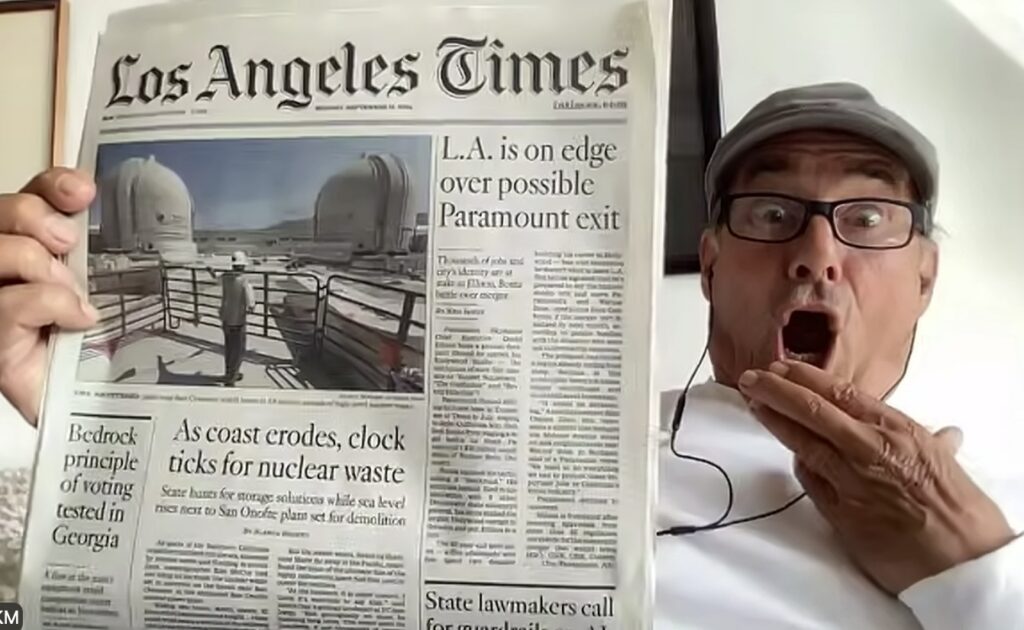
inform themselves in real time. I just hope that things like you might have seen
the cover of the LA Times on the 14th of September of this year. It reads, "As
the coast erodes, clock ticks for nuclear waste. State hunts for storage solutions
while sea level rises next to San Onofre plant set for demolition."
That was on the 14th of September. That went into the Congressional Record.
Shortly thereafter, there was an energy hearing, and I think it was
Representative Scott Peters, who is from San Diego area, not only held up the
article, but also asked that it be put into the Congressional [00:31:00] Record In
a similar manner in the Senate, I think it was the senator from Delaware was
talking about low-lying portions of Delaware, and was asking, in light of the
article in the LA Times, what should Delaware be doing?
They don't have any nuclear sites, but nuclear waste is transported through
Delaware. And in the low-lying areas, what should Delaware do to mitigate any
issues of nuclear waste being transited? Now, of course we have the, as I
mentioned earlier, the railway north-south between San Diego and Los Angeles,
which is the railway that would be used to remove or take anything to and
from...
It's currently being used, to and from San Onofre. When that's compromised,
there is no heavy things weighing 50 tons and more, no method by which they
can move things. I might be wrong, might be 100 tons. But certainly any large
structures or many, many [00:32:00] boulders cannot be transported. So the LA
Times article from the 14th of September really outlined that, and I would
suggest to anyone who has access to that, please read it, because it is a decent
article.
Low probability of something happening, but a black swan event could be
devastating to Southern California.
Libbe HaLevy: If we can find a non-paywall link to that article, we will have it
up on the website. Kim McCoy, you are a treasure to have as a resource here for
Nuclear Hotseat. We appreciate your book Waves and Beaches, which I'm in the
middle of reading right now.
Kim McCoy: Oh, great.
Libbe HaLevy: As anything further comes up regarding San Onofre and these
storms, we will want to hear from you for an update.
Kim McCoy: Well, great. Thank you very much, Libby, for having me. And I
am as interested as you are in really finding out what happens at San Onofre,
and I hope that there's nothing to find out.
But if there is, [00:33:00] I wish there was a webcam there so we could find out
sooner than the public emergency people are gonna inform us. Thank you very
much.
Libbe HaLevy: And thank you for being with us on Nuclear Hotseat. Physical
oceanographer Kim McCoy. You can contact him at
kmccoy@oceansensors.com. We'll have that link up on the website.
We will also link to his book, Waves and Beaches: The Powerful Dynamics of
Sea and Coast. That will be up on our website, nuclearhotseat.com, under this
episode, number 799. Stick around because we'll have more in just a moment
with Karl Grossman. But first, when it comes to covering nuclear issues, the
stories never end.
Nuclear power, nuclear weapons, radioactive waste, uranium mining, radiation
exposure, the current massive drive to promote nuclear energy, citizen pushback
against it. It is enough to fill up [00:34:00] a network of its own. But finding
reliable information you can trust that has not been twisted by nuclear industry
propaganda is another matter entirely.
See, the nuclear industry has a multimillion-dollar public relations machine, and
they constantly push out their own stories and talking points. Government
agencies follow suit and fall in line with their talking points based on the
industry's talking points, and mainstream media either picks up the nuclear
industry's version of things unquestioningly, gives these stories only a passing
glance, relegates local activists and victims to the very bottom of their stories,
or misses them altogether.
That's why Nuclear Hotseat is here. Every week, we bring you information,
voices, and perspectives you're unlikely to hear anywhere else. We follow the
stories, ask the questions, and do it independently without taking any money
from the nuclear [00:35:00] industry. But that independence is expensive, and
our ability to continue it depends on you Nuclear Hotseat is a nonprofit, and
listener donations are what keep this program going.
So if you value having an independent source of nuclear information, if this
program has ever taught you something, alerted you to something important, or
simply reassured you that you're not the only one paying attention, please help
support it. Go to nuclearhotseat.com and hit the Donate button. You can also
donate through Zelle at info@nuclearhotseat.com.
Any amount helps. A sustaining donation of even five dollars a month helps
give us the financial stability to keep showing up week after week. Nuclear
Hotseat is a 501 non-profit, so your donation is tax-deductible to the extent
allowed by law. This is important because independent information doesn't just
appear.
Someone [00:36:00] has to do the work and make sure the work can continue.
So here's the deal. I'll continue to do the work, and you help make sure Nuclear
Hotseat can keep doing it. So please donate today at nuclearhotseat.com, and
thank you for caring enough to keep this independent voice alive. Now back to
this week's second featured interview.
Nuclear and NASA. The specter of nukes in space with reactors and their waste
on the Moon and Mars is being promoted on multiple levels of the government
and industry. What does it mean for our future? What do we know about past
nuclear incursions in space? And what, if anything, can we do about it? To find
out more, I spoke with Karl Grossman.
He is an award-winning environmental journalist who has covered nuclear
issues for more than 50 years. His most recent article in CounterPunch is The
Nuclear NASA Era, and that's what we [00:37:00] talked about on October
16th, 2026. Karl Grossman, it is always an honor to have you back with us on
Nuclear Hotseat.
Karl Grossman: It is a pleasure as always to be with you, Libby.
Libbe HaLevy: Since the first of the year, Trump has been issuing a series of
executive orders on nuclear matters. What has he been doing, and what does it
look like he's setting us up for?
Karl Grossman: In terms of the nuclear situation, all kinds of things. I mean,
he's pushing nuclear power on the planet's surface.
He essentially has all but taken control of the Nuclear Regulatory Commission,
which never really was a watchdog, and now it's beyond being a lapdog. He's
discouraging in any way he can safe, clean, renewable energy, solar and wind
and so forth, and he's intensely, intensely pushing nuclear. Now, beyond the
surface [00:38:00] of the planet, his administration is also pushing very hard.
I just did an article, this is a few weeks ago, it was on CounterPunch. We are
entering the nuclear NASA era, which represents a major transformation for
space exploration, and those words are from Jared Isaacman. He is the
administrator of NASA, and alongside him was the US Secretary of Energy,
Chris Wright, who incidentally came from the fracking industry.
Now he's done a switch to being a full-throated advocate of nuclear power in
every way. In terms of what NASA has in mind, we're talking about nuclear
reactors on the moon Sending a nuclear-powered space probe to Mars, and this
is all gonna be coming very soon. The nuclear probe to [00:39:00] Mars is in
late 2028.
It's like, you know, a year and a half away. And meanwhile, they wanna get a
nuclear reactor started in 2028 too, going on, on the Moon. And this will just be
the, the beginning of this scheme of nuclear-powered colony on the Moon,
nuclear-powered colony or colonies on Mars. This is so unnecessary. For
example, NASA for a, a brief, shining moment began using solar power.
In 2011, NASA launched a solar-powered space probe to Jupiter. It's called
Juno. Got there in 2016. Everything was fine. It's been exploring around Jupiter.
Now let me just give you some background here. When I came into this issue,
we're talking about 1986, May of '86, was to launch a [00:40:00] nuclear-
powered space probe called Galileo.
To Jupiter. If there would've been a launch accident that occurred in, in
February, and the 48 pounds of plutonium on Galileo ended up being dispersed
as dust, from a, a terrible tragedy, it would've been a widespread calamity.
Plutonium has long been described as the most toxic radioactive substance. So
here was the Galileo mission.
It was finally actually... They got nervous about putting it on a space shuttle, so
finally they had it launched towards Jupiter on a Centaur rocket. Again, all kind
of danger as opposed to doing this mission to Jupiter as it was successfully done
with solar a few years later. Now, however, what that announcement was all
about, the nuclear NASA era, they wanna go nuclear, nuclear, nuclear.
In fact, the [00:41:00] article on this announcement, which I wrote about, the
story in World Nuclear News, a very pro-nuclear publication, says that deep
space exploration is trading chemical rockets for nuclear fission. In other words,
nuclear rockets and nuclear space probes, and, uh, nuclear colonies. The kinda
thing that Trump would like to see on Earth.
New nuclear power plants, a nuclear power renaissance, a push for small
modular reactors and so-called advanced reactors, which in fact aren't advanced.
These are old designs which didn't work several decades ago when they were
first brought out. Now we would get them today. This would be on Earth. We
would have nuclear, nuclear, nuclear, even though safe, clean, renewable energy
is, is cheaper, it's available, it's more efficient.
The space [00:42:00] agency, NASA, would become a nuclear NASA, and
using nuclear in every possible way.
Libbe HaLevy: NASA sent out a press release that you cite in your article that
reads in part, "Nuclear power will energize habitats, communications,
instruments, rovers, resource usage, and critical lunar infrastructure, and it will
be essential for demanding energy needs for future Mars missions."
So there's this space-wide vision of using nuclear to get everywhere, but what
do we know about the kinds of accidents that can happen, some of which have
already happened?
Karl Grossman: The first really serious accident involving plutonium.
Plutonium is a man-made substance. It's, it doesn't exist until you expose
uranium-238 in fission.
A millionth of a gram constitutes a fatal [00:43:00] dose in terms of lung
cancers. After the Manhattan Project, and the Nagasaki bomb was fueled with
plutonium, and plutonium was really developed during the Manhattan Project.
People who are dog lovers, don't listen to this, but they did a series of tests with
beagle dogs, and they had them inhale the tiniest and minutest amount of
plutonium, and lung cancer 100% of the time.
In any case, way back, and we're talking here in the '60s, satellites that were
sent up were energized by plutonium. And then what occurred was, this was in
1964, April 1964, a satellite fueled by plutonium didn't achieve orbit, came
falling back to Earth, spreading plutonium all over the planet. In fact, Dr.
John Gofman of the University of California at Berkeley, an MD and a PhD,
who was involved, uh, in early work with plutonium during the Manhattan
[00:44:00] Project, he long said that there was a spike in lung cancer- On the
Earth because of this, the reactor system, the plutonium system was called the
SNAP-9A.
Because of the SNAP-9A accident, the SNAP-9A came falling back to Earth,
disintegrated as it hit the atmosphere, spreading plutonium actually, or
essentially all over the planet. What did NASA do in response? Well, again, it
was a period of some, some intelligence at NASA. It started figuring out some
other way to power satellites, and NASA became a pioneer in space solar
power.
Now, any satellite launched, at least up to now, before it became NASA
Nuclear, but every satellite launched for decades is solar powered. The
International Space Station is solar powered. So it's like on Earth and in space,
there's a clear alternative. We can use [00:45:00] safe, clean, green, renewable
energy, or we could use toxic, beyond just toxic, lethal nuclear power in space,
and the choice has to be made, and meanwhile, the choice is being made for us,
would be made for us by the Trump administration, sending NASA back into a,
a different direction, into a government agency with our tax dollars,
incidentally, neck-high in all kind of nuclear plans.
Libbe HaLevy: There's another aspect that I haven't heard mentioned. On
Nuclear Hotseat number 626 back in June of 2023, I interviewed Professor
Steven Starr, who'd written a book that explained that a single nuclear weapons
explosion in space above, say, Central America, could fry the US electric grid,
destroying it completely, possibly beyond the point of repair or reclamation I
don't know if the same kind of [00:46:00] explosion could happen from
something that is nuclear powered in space.
But if something like that blew up, has that been at all part of the discussion,
part of the consideration, the EMP angle in the discussion of nukes in space?
Karl Grossman: That problem continues to exist. I mean, the US has, decades
ago, tested nuclear weaponry in space, and essentially the lights went out in
Hawaii because of the EMF impact.
That problem still exists. But meanwhile, we're taking this man-made poison,
plutonium, spreading it, and spreading it in, not just on Earth, but into the
cosmos. For example, the Galileo space probe with the 48 pounds of plutonium.
Again, NASA has its very dark side. Some people in NASA have tried to do
good things.
It was crashed back into Jupiter, and at the end of its mission they decided,
"Well, let's just send it into Jupiter." Now you have [00:47:00] plutonium on
Jupiter as a result. And also with this is all these plans of reactors on the Moon
and on, on Mars. What's gonna happen after their so-called lifetime? There's not
exactly nuclear waste repositories on Mars or on the Moon or elsewhere.
We're spreading this man-made nuclear poison through the solar system. It's
criminal And it has to be stopped.
Libbe HaLevy: That was one of the points that I wanted to get to, because
plutonium is manmade. It doesn't exist in nature anywhere, which means that it
can be considered the signature of planet Earth and human beings anywhere in
the solar system or beyond when it shows up.
And we have now contaminated Mars, Jupiter. We're going after the moon.
We've contaminated all of these ecosystems, for whatever they consist of,
without [00:48:00] knowing what the impact would be of plutonium. We know
what the impact would be here on Earth because we've experienced it, we've
known it, but there's no knowledge of what we may have done to previously
plutonium-free, pristine environments, and how it will play out in the future.
We're willy-nilly playing around with creation here. Have there been any moral
or ethical discussions of this, or is it just kind of, "Rah, rah, nukes, let's keep
pushing forward"?
Karl Grossman: It depends. We have had certain people in political office, for
example, Congressman Edward Markey of Massachusetts, who understands the
dangers, the toxicity, the lethality of nuclear technology.
Markey understands that it, it's not necessary. In California, Mark Jacobson, a
professor at Stanford University who has recently written a book, No Miracles
[00:49:00] Needed. There's no need for any kind of miracle substance in terms
of providing energy. We can get all the power we need from solar and wind and
other green energy sources.
And Dr. Jacobson is very clear nuclear is not needed. My first book on nuclear
power, Cover Up: What You're Not Supposed to Know About Nuclear Power is
its title. In fact, listeners could get the book for free on my website. Just go to
CarlGrossman.com and go to the books page, and you can download for free
courtesy of the publisher.
And I g- I started off, it's, it's from the Bible, "I have set before you darkness
and light, life and death," and I'm paraphrasing, and I shouldn't paraphrase the
Bible, "Choose life so you and your descendants may live." That's the choice
here. I mean, this is heavy-duty stuff, and we have a choice, and we have to
insist through our vote, through our actions, that [00:50:00] our governments
choose life, choose light, choose safe energy, and thus those who come after us
can live.
Libbe HaLevy: One more point. To use the Watergate term, follow the money.
With this big push towards nuclear, be it on the Moon or the Earth, or the
number of places where it's being contemplated, who stands to gain the most
from this expansion of the NASA-nukes connection and the aim to put nuclear
reactors on the Moon?
Karl Grossman: The giant aerospace corporations, a major factor, but also the
government bureaucracies. Out of the Manhattan Project came all these national
laboratories, Oak Ridge and Los Alamos, and there are these bureaucracies, uh,
created by the Manhattan Project, which became the Atomic Energy
Commission in 1946, which is this [00:51:00] vested interest that was created
way back when continues.
And between the corporations looking to make a buck and these bureaucracies,
not just these many national laboratories spread around the country, but in
Washington, DC, the, the Atomic Energy Commission was ultimately broken up
into a Department of Energy and the US Nuclear Regulatory Commission. And
both are just pushers, promoters, because of vested interest of nuclear at some
partnership.
Libbe HaLevy: Anything you'd like to add?
Karl Grossman: Dr. Helen Caldicott has said, in fact I quote her as saying this
in Cover Up, "We are in the hands of lunatics at the crossroads of time." That's
what Dr. Caldicott said, and that's the situation today.
Libbe HaLevy: Well, I for one appreciate your sanity, and the fact that there are
others who are fighting against this and trying [00:52:00] to change the
narrative and change the actions before it's too late.
Karl Grossman: Yes.
Libbe HaLevy: Karl Grossman, you are a treasure who has been a terrific
mentor to me and a terrific support to my work. In truth, you've been a support
to all of us who fight against nuclear, and I wanna thank you for once again
being my guest this week on Nuclear Hotseat.
Karl Grossman: A pleasure being with you, as always.
Libbe HaLevy: That was award-winning veteran environmental reporter Karl
Grossman. We will link to his CounterPunch article, The Nuclear NASA Era, on
our website, nuclearhotseat.com, under this episode, number 799. We will also
have links to a free PDF of his book, Cover Up: What You Are Not Supposed to
Know About Nuclear Power.
And we will be including a link to the Stephen Starr book we mentioned,
Nuclear High Energy Electromagnetic Pulse, A Mortal Threat to the US Power
Grid [00:53:00] and US Nuclear Power Plants. You'll get the details to all of this
on our website, nuclearhotseat.com, under this episode, number 799.
Activist Shout-out: Activist shout outs
Libbe HaLevy: Susi Snyder is Director of Programs for the International
Campaign to Abolish Nuclear Weapons, or ICAN. Before that, for many years
she was with PAX Netherlands, which is where the program Don't Bank on the
Bomb was initially generated and implemented. It outlines a practical program,
really simple, that any one of us can take if we believe that the building of
nuclear weapons and the delivery systems for them should be stopped.
It's about taking away the money. Here's Susi from when I first spoke with her
many years ago, where she outlined exactly what Don't Bank on the Bomb is
and what we can do [00:54:00] to participate in it.
It's amazing. It's called Don't Bank on the Bomb, and that's the website, too,
dontbankonthebomb.com. Step one, find out if your bank invests in nuclear
weapon producers.
Step two, contact your bank. Tell them you don't want them to. Step three, tell
the world what the bank says, and if they don't get rid of investments, go public,
because no bank wants to look like a bad guy. It takes one or two people only to
make a huge difference, and that can cut off the money stream to the companies
that make nuclear weapons.
You and I, we have more power than we think, and that power's sitting in our
wallet.
Libbe HaLevy: And how can people find out whether the companies that we're
told the bank is supporting have any connection with the nuclear weapons
industry?
Well, we do a, a significant investigation every year. Now, it's not completely
exhaustive, but we profile 28 companies that have association with nuclear
weapons modernization and maintenance, and it's on [00:55:00] our website,
dontbankonthebomb.com, and we really want people to use our information and
contact us all the time.
You can do that in, you know, through the website really easily. Contact me on
Twitter, whatever works, and I'm happy to find out more. And if you find out,
learn about more companies involved in nuclear weapons, tell us. We'll do the
research, and we'll make it public for everybody to use. Love it.
Libbe HaLevy: Susi Snyder.
At the time we initially spoke, she was with dontbankonthebomb.org. She is
now Director of Programs for the International Campaign to Abolish Nuclear
Weapons. ICAN and PAX have joined to make the removal of finances from the
nuclear weapons producing companies an international collaboration between
PAX and ICAN.
We will have links up on our website, nuclearhotseat.com, under this episode,
number 799, if you wish to explore this further, and I urge you to do so. The
[00:56:00] Outrider Foundation will be holding its annual Nuclear Reporting
Summit this week, Thursday and Friday, October twenty-second and twenty-
third. This brings together journalists from around the country and truly around
the world, along with national security experts, to explore the nexus of health,
climate, artificial intelligence, outer space, and national security for a series of
knowledge-building conversations focused on exploring the interconnectedness
of these issues in the new nuclear landscape.
This year, it's being held in Los Angeles, which means it's also including TV
and movie screenwriters, producers, directors, and content creators to discuss
nuclear industry issues and how they might relate to future programs and
entertainments. Among the panelists will be Jeff Gipe, documentary filmmaker,
Half-Life of Memory: America's Forgotten Atomic Bomb Factory about Rocky
Flats, and [00:57:00] Melissa Bumstead, founder of Parents Against the Santa
Susana Field Lab and a regular interviewee here on Nuclear Hotseat.
I will be attending, and I'll bring you a special report about this special event in
the coming weeks. And next week, we hit a milestone, episode number eight
hundred of Nuclear Hotseat. We take a look back at some highlights from the
fifteen and a half years of weekly episodes and share with you our plans for
twenty twenty-six and beyond as we continue the revamp of the website and
expanded access routes to the archive, as well as launching a YouTube channel
and showing up in unexpected places on social media.
That's next week, Nuclear Hotseat number eight hundred. For now, this has
been Nuclear Hotseat for Tuesday, October twentieth, twenty twenty-six. You
can sign up to get Nuclear Hotseat delivered via email every week as soon as it
posts by going to nuclearhotseat.com. [00:58:00] Put in your first name and
email address, and every week you will get one email with a link and a short
description of the show's content.
So much is happening in the nuclear world, and it's happening so quickly that
you won't want to miss a single episode. If you have a story lead, a hot tip, or a
suggestion of someone to interview, send an email with that information to
info@nuclearhotseat.com. And remember, if you can go to Nuclear Hotseat and
donate, thank you.
Any amount will help us, one time only or as a sustainer, and we really
appreciate all of your support. This episode of Nuclear Hotseat is copyright
2026 Libbe HaLevy and Nuclear Hotseat. All rights reserved, but fair use
allowed as long as you cite the program, website, names of any guests whose
comments you use, and me.
For now, this is Libbe HaLevy of Nuclear Hotseat [00:59:00] reminding you
that the one thing that no one who opposes nuclear ever wants to be able to say
is, "I told you so." There you have it, your weekly nuclear wake-up call. So
whatever you do, don't go back to sleep because we are all in the Nuclear
Hotseat.
Nuclear Hotseat Theme: Nuclear Hotseat. What are those people thinking?
Nuclear Hotseat. What have those boys been drinking? Nuclear Hotseat. The
corium is sinking. Our time to act is shrinking, but our activists are linking.
Nuclear Hotseat. It's da bomb